Preschool Line Tracing Worksheets
Straight, slanted and curved lines to trace, with a green start dot on every line to show where to begin.
Customize
More options
The preview updates as you change the settings.
Why line tracing comes before letters
Every letter is built from a few simple strokes: lines that go across, down or slant, and curves. Children who can draw those strokes with control find letters much easier later on. Line tracing is a low-pressure way to practice, because there is nothing to read and nothing to get wrong. It is also a good way to see how your child holds a pencil.
The four patterns on this page
- Straight lines across from left to right. This is the direction we read and write, and it prepares for the crossbars of t, f and e and for lines of writing.
- Standing lines from top to bottom. These are the stems of letters such as l, i, b, d and p.
- Slanting lines prepare for v, w, x, k and the capital A. They are harder than straight lines, so expect some wobble.
- Curved bridges prepare for the round parts of c, o, a, n and m.
Which order to practice them in
Children usually master lines in a similar order: across, then down, then curves, and slanting lines last. If a pattern is too hard, go back to the one before it, and try again in a week or two. The settings are set to the Beginner level, with big gaps between dots and one line in each row.
How to help
- Use a fat crayon, a short pencil or a chunky triangular pencil. Short tools make children hold their fingers closer to the point.
- Point to the green dot and say "start here", then follow the arrow with your finger before you pick up the pencil.
- Keep the paper steady with the other hand, and tape it down if it slides.
- Stop while it is still fun. Four to six rows is a good session.
What to try next
For waves, loops and spirals, try the curves and loops worksheets. When lines are comfortable, practice shape tracing and then letter formation. A few minutes with cutting practice builds the same hand control.
Frequently asked questions
At what age can children trace lines?
Many children enjoy tracing simple lines from about age three. Younger children are still learning to hold a crayon, so use big lines and plenty of praise.
Which pencil grip should my child use?
Children usually move through several grips before settling on one. Encourage a pinch between thumb and first finger with the pencil resting on the middle finger, but do not insist on it at age three. If you are concerned, ask your child's teacher.
Why do some lines have arrows?
The arrow shows which way to go. Most lines start on the left or at the top, because that is how we write letters and words.
Free printable workbooks
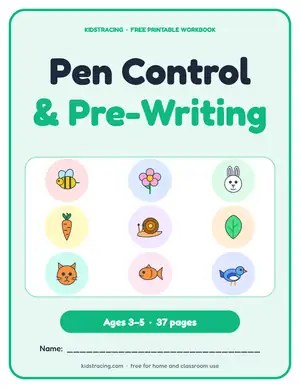
Want a planned set instead of a single page? These free PDF workbooks use the same worksheets in a step-by-step order.
Related worksheet tools
Explore more: Handwriting and Tracing Worksheets for Kids · Preschool Worksheets · All free worksheet tools
Guides for parents and teachers: Pre-Writing Shapes by Age: When Can Kids Draw Each Shape?