Pre-Writing Lines Worksheets
Build pencil control before letters. Choose patterns and a difficulty level, then print a line-tracing worksheet for preschoolers.
Customize
More options
The preview updates as you change the settings.
What are pre-writing skills?
Before children can write letters they need to control a pencil. Pre-writing skills are the basic strokes that every letter is made from: vertical and horizontal lines, diagonals, circles, curves and loops. Practicing these shapes as patterns builds hand strength, eye-hand coordination and a feel for direction, so that real letters feel familiar when they arrive.
How to use the generator
- Choose the patterns you want. Each row of the worksheet uses the next pattern in your list.
- Pick Beginner, Intermediate or Advanced.
- Set the number of rows, check the preview and press Print or Save as PDF.
Choosing a level
- Beginner uses big, widely spaced shapes and thick dots, with only a few repeats. It suits children of about two and a half to four.
- Intermediate makes the shapes smaller and adds more repeats.
- Advanced uses tight patterns with many repeats and several lines at once, for children of five and older who are nearly ready to write.
What each pattern prepares
- Straight lines from left to right teach reading direction and prepare letters such as e, t and f.
- Standing lines prepare l, i and t.
- Slanting lines prepare v, w, x and k.
- Curved lines prepare the humps in n, m and h.
- Waves and zigzags teach smooth, controlled changes of direction.
- Loops prepare cursive e and l.
- Spirals build wrist control and prepare round letters such as a, c and o.
Tips for success
Start with a chunky crayon or pencil rather than a thin pen. Say a rhyme as you trace, for example “up and over, down and under”. It is fine if the line wobbles at first; stop when your child tires and come back another day. Large movements on a whiteboard or in sand are also a good warm-up before paper.
Frequently asked questions
What age is pre-writing practice for?
Most children start between about two and a half and four, and keep practicing until their letters are confident, often around age five or six.
My child cannot stay on the line. Is that normal?
Yes. Control grows with practice. Try the beginner level, use a thicker pencil and praise effort rather than accuracy.
Can I choose just one pattern?
Yes. Select only that pattern and every row will use it.
Ready-made Pre-Writing Lines worksheets
- Preschool Line Tracing – Straight, slanted and curved lines for beginners.
- Curves, Waves and Loops – Bridges, waves, loops and spirals to trace.
Free printable workbooks
Want a planned set instead of a single page? These free PDF workbooks use the same worksheets in a step-by-step order.
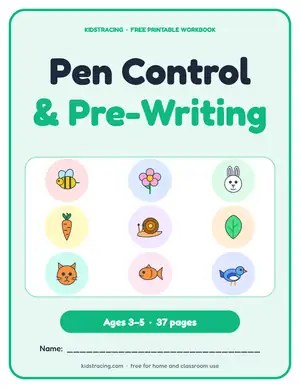
Pen Control and Pre-Writing Book
Lines, curves, zigzags, loops and spirals, plus paths from a bee to a flower, to build pencil control.
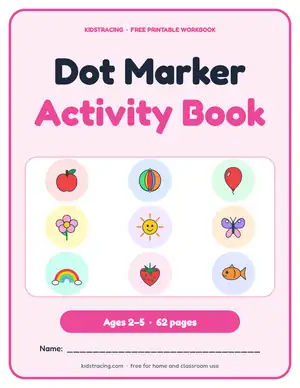
Dot Marker Activity Book
Big letters, numbers, shapes and pictures filled with circles for dot markers, stickers or fingertips.
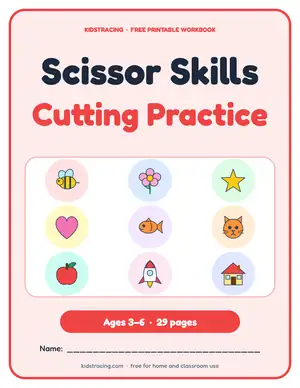
Scissor Skills Cutting Practice Book
Cutting practice from first snips to zigzags, shapes and pictures to cut out and color.
Related worksheet tools
Explore more: Handwriting and Tracing Worksheets for Kids · Preschool Worksheets · Kindergarten Worksheets · All free worksheet tools
Guides for parents and teachers: Pre-Writing Activities for Preschoolers: 15 Fun Ideas · Handwriting Readiness Checklist: Is Your Child Ready to Write? · Pre-Writing Shapes by Age: When Can Kids Draw Each Shape? · Letter Formation Order: Which Letters to Teach First