Handwriting and Tracing Worksheets for Kids
From first pencil lines to joined writing, choose the generator that fits where your child is now.
Free handwriting worksheet generators
Name Tracing
Turn any name into dotted tracing letters.
Letter Formation
A–Z strokes with numbered arrows and dotted tracing.
Cursive Writing
Cursive alphabet, names, words and sentences.
Pre-Writing Lines
Lines, curves, waves, loops and spirals at three levels.
Word Tracing
Trace any list of words, one word per line.
Blank Handwriting Paper
Printable 3-line writing paper.
Ready-made worksheets
- Cursive Name Tracing worksheets – See any name in cursive and print a tracing sheet.
- Days of the Week worksheets – Trace Monday to Sunday.
- Months of the Year worksheets – Trace January to December.
- Body Parts worksheets – Head, eyes, nose, hand and more.
- Preschool Line Tracing worksheets – Straight, slanted and curved lines for beginners.
- Curves, Waves and Loops worksheets – Bridges, waves, loops and spirals to trace.
Free printable workbooks
Ready-made PDF books on the same skill, to print in a planned order.
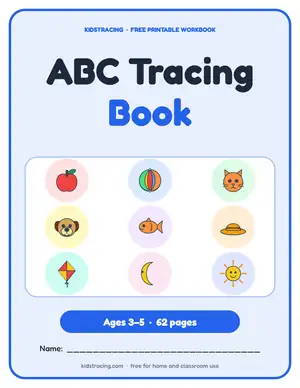
ABC Tracing Book
Every letter A to Z with numbered stroke arrows, a picture to color and a word to trace.
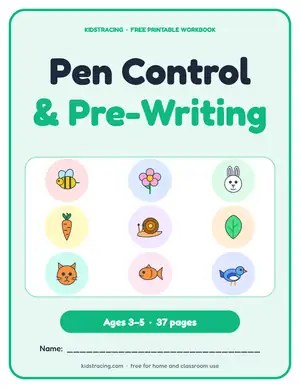
Pen Control and Pre-Writing Book
Lines, curves, zigzags, loops and spirals, plus paths from a bee to a flower, to build pencil control.
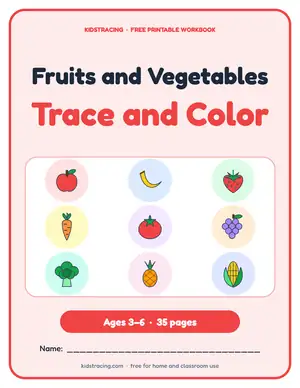
Fruits and Vegetables Tracing and Coloring Book
Color 26 fruits and vegetables, trace each word and write it alone, then review with matching games.
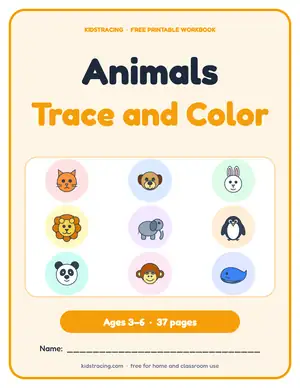
Animals Tracing and Coloring Book
Color 28 animals from the farm, the garden and the wild, trace each name and write it alone.
Where to start
Handwriting develops in stages. Young children begin with pre-writing lines to build pencil control. Next come shapes and letter formation, where the direction and order of every stroke matter. Once letters are steady, children enjoy writing their own name and then whole words, and many schools introduce cursive writing from about age seven.
How to choose a worksheet
Pick a tool that matches the skill your child is working on this week. If they cannot yet hold a pencil comfortably, use pre-writing patterns. If they know some letters but reverse or misstart them, use letter formation. If they are proud of their name and want to write it, use name tracing. For spelling lists and topic words, use word tracing.
Short, regular practice works better than long sessions. Five to ten minutes a day is enough for most young children.
What each handwriting tool is for
- Name tracing turns any name into dotted letters. A child’s own name is often the first word they want to write.
- Letter formation shows A to Z with numbered start points and direction arrows, so letters are learned the right way from the start.
- Pre-writing lines practice lines, curves, waves, loops and spirals at three levels.
- Word tracing traces any list of words, such as spelling words, days of the week or body parts.
- Cursive writing covers the joined alphabet, names, words and sentences.
- Blank handwriting paper gives you plain three-line paper for free writing.
Print first, then cursive
Most children learn print letters first. Many schools introduce cursive at about age seven or eight, although this differs by school and country, so it is worth asking your child’s teacher which style they use.
Comfortable posture helps
Let your child sit with both feet on the floor and the paper slightly tilted. A short pencil or a broken crayon encourages a relaxed pinch grip, and a few shoulder rolls before writing can make the session more comfortable.
Browse by age: Preschool Worksheets · Kindergarten Worksheets
Frequently asked questions
At what age should children start handwriting practice?
Most children are ready for pre-writing lines and tracing their name at three to four, and for letter formation at four to five. Always follow your child’s interest and hand strength.
Should my child learn capital or small letters first?
Both approaches are used. Many parents begin with the capital letter in the child’s name. The letter formation worksheets show the capital and the small letter side by side, so you can work on either.
Can left-handed children use these worksheets?
Yes. Left-handed children may find it more comfortable to turn the paper slightly clockwise and to hold the pencil a little higher, so they can see what they write.
How long should a handwriting session last?
Five to ten minutes is plenty for young children. A short, happy session each day works better than one long one.